The backend
A Filament admin that photographs well.
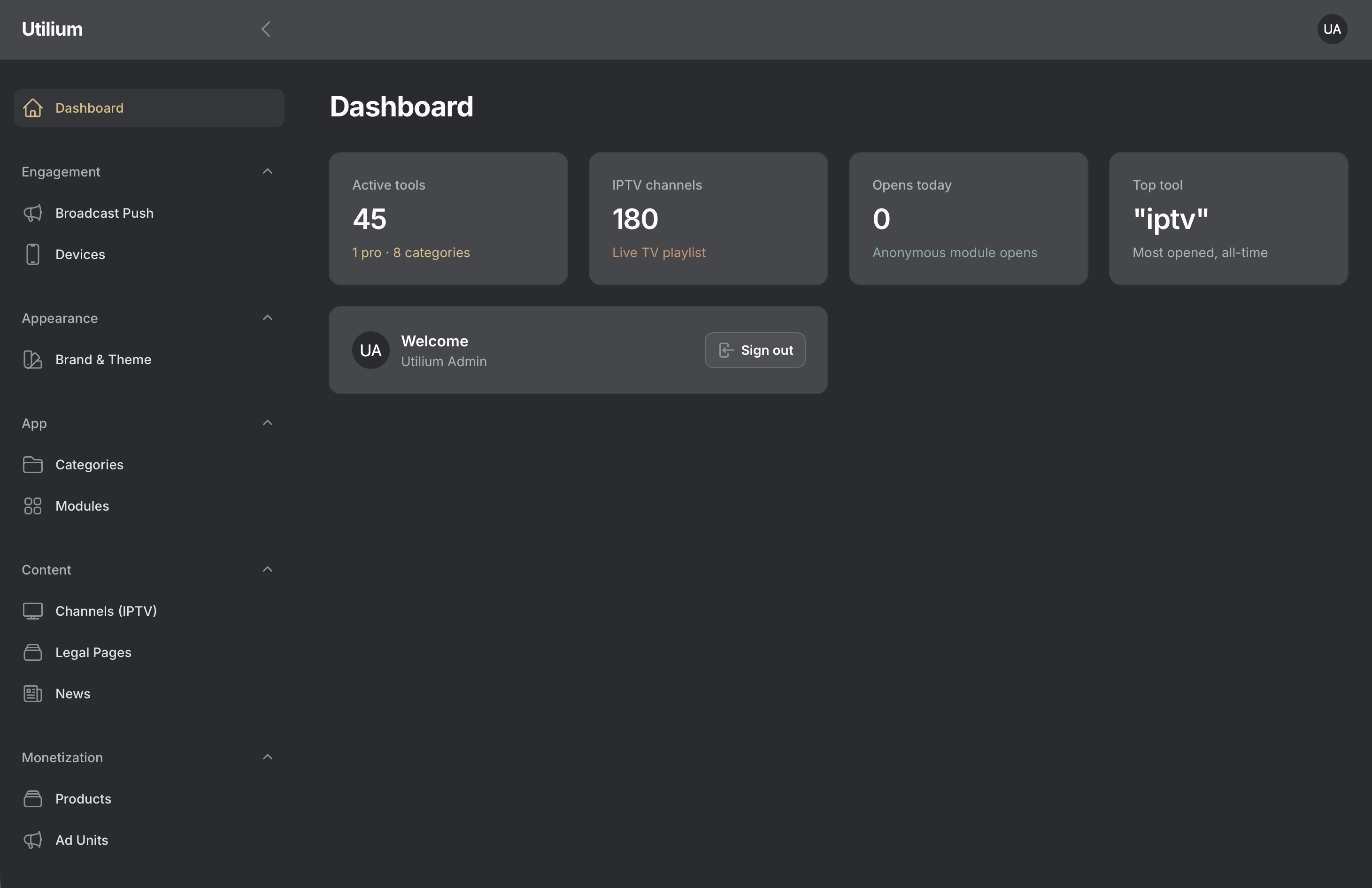
Buyers judge a template by its backend. This one wears the same brass-on-ink identity as the app — Categories, Modules, Channels, Legal, Products and Ad Units, plus a Brand & Theme page.
Utilium is one Flutter app holding 45+ self-contained utilities. Toggle, reorder, tier and rebrand every one of them from a Laravel admin — no code, no rebuild.
Real Cupertino on iOS, Material 3 on Android — not one skin stretched across both.
Most “all-in-one toolbox” templates are one skin over a grid of forms. Utilium ships a real design system, a real video engine, and an admin that does genuine no-code work.
Switch whole categories or individual tools on and off, set free/pro tiers, and drag to reorder — live, from Filament, no rebuild.
Live TV plays genuine HLS/M3U8 through the native video pipeline — not a WebView hack — with a server-parsed channel list.
Name, colors, fonts, logo, legal pages and onboarding — all admin-editable and applied at app boot. Buyers make it theirs in minutes.
No sign-up anywhere. Notes, history, expenses and pins never leave the device — a clean privacy story and zero auth backend.
AdMob placements and a one-time “Pro Unlock” IAP, with unit IDs, frequency caps and gating all configured from the panel.
Every tool is a self-contained folder. Delete the ones you don’t want and the build still ships — the “only 10 of 25” story is true in code.
This list is generated from the same catalog the app and API read. Turn any of it off for your audience.
Buyers judge a template by its backend. This one wears the same brass-on-ink identity as the app — Categories, Modules, Channels, Legal, Products and Ad Units, plus a Brand & Theme page.
No. Name, colors, fonts, logo, legal pages, onboarding and which tools are on are all edited in the Filament admin and applied on next app open — no rebuild, no store review.
No. The app ships as a player. You supply your own M3U playlist in the admin and are responsible for the rights to whatever you point it at. Public test streams are seeded as a working example.
Yes. The UI forks at the widget layer — Cupertino navigation, pickers and sheets on iOS; Material 3 on Android — sharing only business logic.
On device. There is no account system; notes, history, expenses and pins live in local storage. The backend is purely a configuration and content layer.